How Information Changed the World
Chapter Three
The Ship That Wouldn't Listen
Radio · 1900s–1940s
The Moment
It is a clear, calm night in the North Atlantic. April 14, 1912. The largest, most modern passenger ship ever built — RMS Titanic, eleven stories tall, about 270 metres long — longer than two and a half football pitches — is four days into her first voyage from Southampton, England to New York City.
At 11:40 p.m., a lookout shouts. An iceberg, directly ahead. The ship has 37 seconds to turn. It is not enough.
Down in a small wooden room near the bridge, two young wireless operators — Jack Phillips and Harold Bride — are still on duty. The captain bursts in and orders them to begin sending distress calls.
Phillips rests his fingers on a brass key not so different from Samuel Morse's. He taps the new international distress code: three short, three long, three short.
… – – – …
SOS.
The signal leaps from the antenna out into the dark in every direction at the speed of light. A ship called the Carpathia, fifty-eight miles away, hears it. She turns and races toward the Titanic. She arrives an hour and a half too late, but rescues 705 people from the freezing water.
Another ship — the Californian — is only about ten miles away. Less than an hour's sailing distance. The Californian has a working wireless too.
But the Californian's single radio operator went off duty at 11:30 p.m. He turned the wireless off and went to bed. When the signals came in, no one was listening.
About 1,500 people die. Many of them die within sight of a ship's lights that could have saved them, if anyone on board had been awake to hear the call.
Before
For most of human history, the ocean was a wall. A ship left port and disappeared. Her families heard nothing for weeks, sometimes months. A ship that sank in deep water often simply never came back, and no one ever knew what had happened to her. The crew was just… gone.
The telegraph that filled Chapter 2 had connected the cities of the world by wire. But you cannot string a wire across the open ocean to follow a moving ship. Once a ship was out at sea, it was alone again.
Wireless began to change this in the early 1900s. By 1912, most large ocean liners carried a wireless room with a paid operator. But there were no rules. Each shipping company decided how many operators to hire, how many hours to listen, and what to do with the equipment.
A radio that nobody monitored was a radio that did nothing.
This is the world the Titanic sailed into — a world where the technology to call for help across hundreds of miles already existed, but where the system around that technology was still being figured out. Where one tired man, in one room, could turn off the only ear listening to ten miles of dark ocean.
The Tech
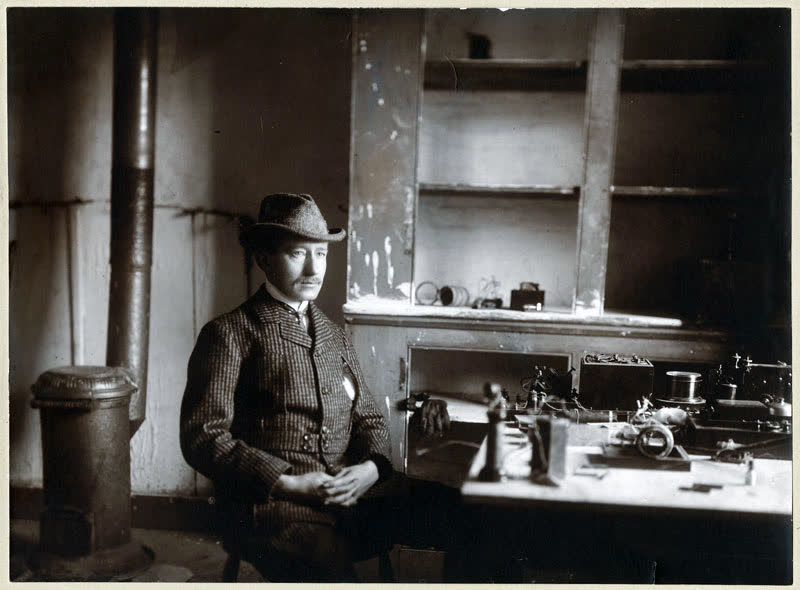
The man who made it possible was Guglielmo Marconi, an Italian inventor obsessed with a strange new branch of physics: the discovery that electricity, properly disturbed, could send invisible waves through empty space.
Where the telegraph needed a physical wire from sender to receiver, Marconi's wireless needed nothing between them but air. A transmitter on one end converted an electrical signal into "radio waves" — invisible vibrations of the electromagnetic field — that radiated outward in every direction. A receiver miles away, tuned to the right frequency, could detect those waves and convert them back into a signal.
In 1901, in a freezing radio shack on the cliffs of Newfoundland, Marconi received a single faint signal sent across the Atlantic from Cornwall, England. The letter S — three short pulses — had traveled about 2,200 miles through the air, with no wire and no path beneath it. Many scientists at the time were not even sure it should have been possible.
For a few years, wireless was used only for sending dots and dashes — Morse code without the wires. But by the mid-1900s, engineers were figuring out how to make radio waves carry voices and music. Soon you would not just hear the click of a faraway message; you would hear a person's actual voice, in real time, from a place you had never been.
The Ripples
The Titanic disaster horrified the world, and out of that horror came rules. Within months, governments on both sides of the Atlantic passed laws requiring every passenger ship to keep its wireless room monitored twenty-four hours a day. The international maritime safety treaties still in force today trace their roots to a tragedy that radio almost — but not quite — prevented.
Then, in the 1920s, came the explosion.
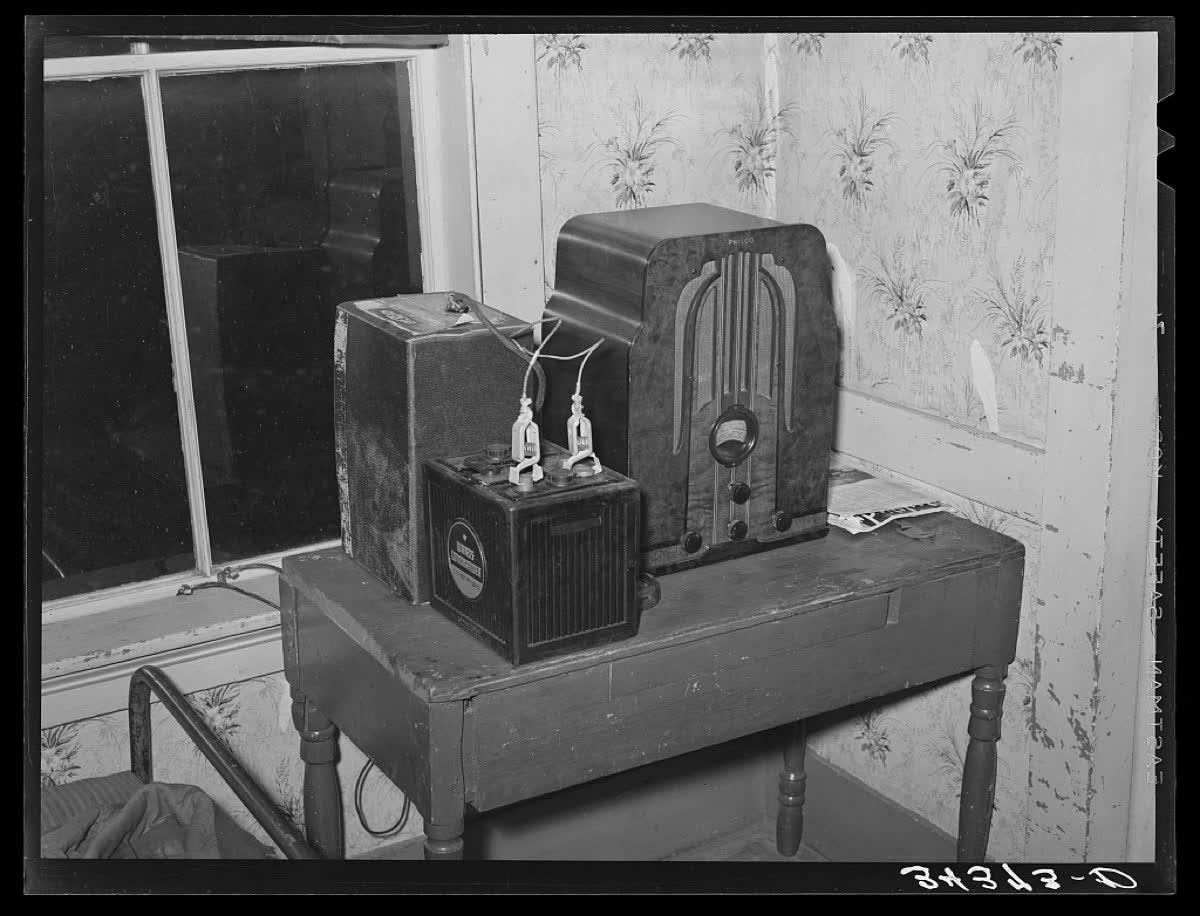
On November 2, 1920, a small station in Pittsburgh, Pennsylvania — KDKA — began broadcasting voices and music to anyone in the area who owned a receiver. Within five years, hundreds of similar stations were on the air across the United States. By 1930, more than half of American homes had a radio set in the living room.
For families, this was a new and almost unbelievable thing. For the first time in human history, you could sit in your own home and hear a person, an orchestra, or a live sporting event — happening somewhere far away — at the very moment it was happening. The entire country could laugh at the same joke at the same instant.
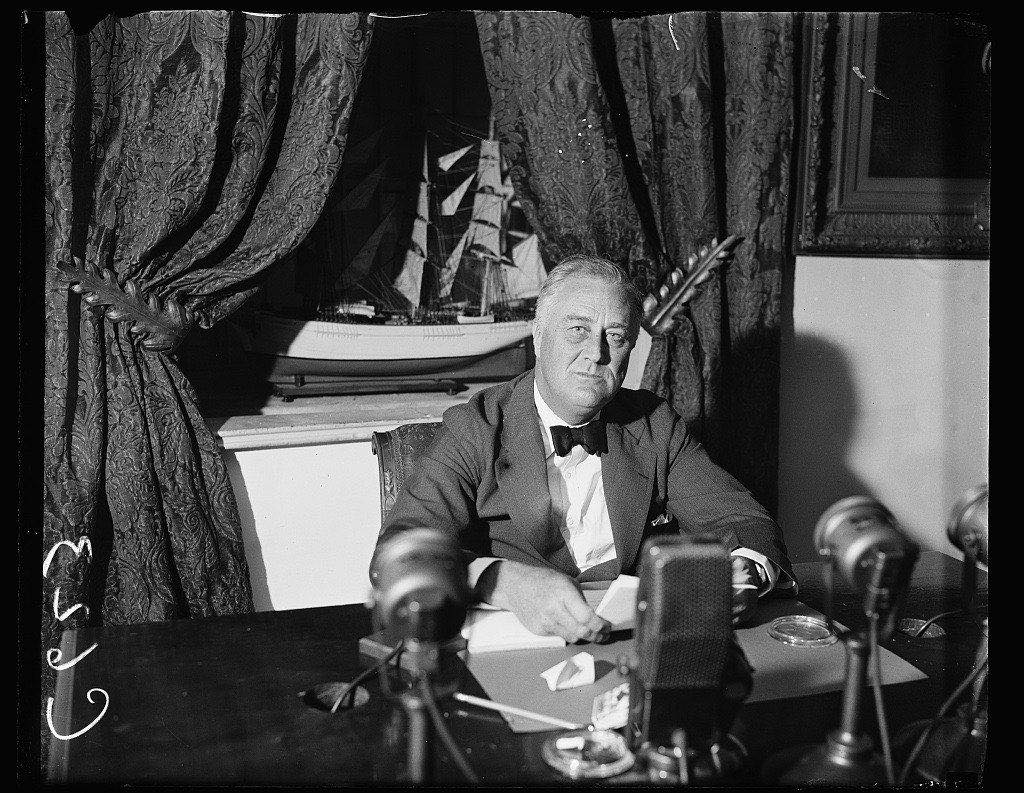
In the 1930s and 40s, U.S. President Franklin D. Roosevelt understood the new medium better than any politician of his time. He gave a series of evening radio addresses — known as the "Fireside Chats" — in which he spoke directly to American families, plainly and warmly, about the economic depression and, later, the war. For most Americans, it was the first time they had ever heard a president's voice. He sounded like a friend at the dinner table. Millions felt they knew him personally, even though they had never seen him in person.
In 1938, on the night before Halloween, the young actor and director Orson Welles produced a radio drama that imitated the style of a real news broadcast. The "news bulletins" announced a Martian invasion of New Jersey — adapted from H. G. Wells's novel The War of the Worlds. Newspapers the next day reported that millions of Americans had been thrown into mass panic. Historians today suspect that much of that "panic" story was exaggerated, possibly by newspapers themselves, who were jealous of radio's rising power and happy to make it look reckless. Either way, the episode revealed something serious: a voice on the radio could feel as real as a voice in your kitchen, even when it was not.
Then came the dark side.
In Germany, Adolf Hitler's Nazi government understood radio's reach as quickly as Roosevelt did, and pointed it in a very different direction. Cheap "people's receivers" were distributed to ordinary households so that every family could hear Hitler's speeches in real time. His rallies — chanting crowds, marching music, screamed slogans — were piped directly into millions of living rooms. Radio in 1930s Germany did not invent the hatred. It poured the hatred into every house in the country, day after day, until it became the air people breathed.
Sixty years later, in 1994, a small radio station called RTLM in the central African country of Rwanda used the same basic technology — voices on the airwaves — to direct one of the worst genocides of the 20th century. Hutu broadcasters read out the names and addresses of their Tutsi neighbours, ordered listeners to kill them, and described it all in cheerful, casual tones, as if announcing a football match. About 800,000 people were killed in 100 days. Many of them were murdered by people they had grown up next to — neighbours holding machetes in one hand and radios in the other.
The same wireless that had once tapped SOS into the dark of the Atlantic could also tap out a kill list.
The Pattern
By now you can probably see the shape coming.
From about 1900 to 1920, radio was a miracle. People wrote about it the way newspapers had written about the telegraph in the 1840s, and about the printing press before that. Invisible voices crossing oceans. Distress signals leaping out into the dark. Surely now, surely this time, the world would understand itself better.
Through the 1920s and into the early 1930s, it became ordinary. A radio in every living room. Bedtime stories beamed in from across the country. Children growing up never knowing a world without it.
By the late 1930s, it was being weaponized. Hitler used it to organize hatred. Some Allied governments used it to organize fear. Sixty years later, Rwandan radio used the same kind of voice in the same kind of room to organize a massacre.
The shape is the same shape from Chapter 1 and Chapter 2. The clock, though, is different.
The printing press needed about 150 years to run through all three stages. The telegraph did it in about 70. Radio did the whole arc in roughly 30. Each new information technology seems to compress the timeline. The next chapters will compress it further.
Pattern Tracker
Chapter 3: Radio
Now
The radio age never fully ended; it just changed shape. The same questions people were asking in the 1930s — about a powerful new medium reaching every home, and who gets to speak through it — keep coming back, in new forms, every few decades.
Reflect
- The Californian had a working radio but no one was listening. What does this story tell us about the difference between having a technology and using it well?
- FDR used radio to comfort Americans. Hitler used radio to organize hatred. Is the radio itself "good" or "bad" — or is the question wrong? Defend your answer.